Most people building in RWA tokenization are looking at the wrong market.
They see $33 billion in onchain real-world assets and assume the opportunity is to expand that universe: more US Treasuries, more US credit, more US instruments on more chains. That is the first wave. It will not be the next one.
The next wave will be the $60 trillion in emerging-market funds, equities, and bonds that have never had a path to global onchain capital.
DeFi’s asset universe hasn’t been built to touch emerging markets. And yet, emerging markets produce 60% of global GDP growth.
Today, $300 billion in stablecoins sit yield-hungry, and cross-border. Their best opportunity to reach meaningful yield won’t be found in US markets. It will be found in emerging markets, by those who understand how to leverage macro opportunities.
What does that look like in practice?
A country changes policy. A peace deal lands. Interest rates flip. Within hours, capital knows exactly where it wants to go: Venezuelan oil equities the day the market reopens, Saudi and Turkish construction during Syria’s reconstruction, the carry in Turkish lira or Brazilian real.
Capital already sits onchain in stablecoins, ready to move.
What it lacks is the infrastructure to execute: a legal entity to hold the position, a local bank account to settle cash, a broker to buy the asset, FX rails to convert USDC into local currency. By the time those pieces are assembled, the window of opportunity has closed.
The platform that captures this capital will not be the one that scrambles to build after the news breaks. It will be the one that was already there.
The first wave of tokenization scaled from under $1B to $15B in tokenized US Treasuries in roughly two years. That worked because US instruments are straightforward: legal structure, custody, compliance, and smart-contract architecture are all easier to handle. Emerging-market tokenization carries every one of those challenges, plus a layer the first wave never had to solve: access to local financial infrastructure.
EM assets sit inside different jurisdictions, denominated in different currencies, held by different kinds of counterparties, reachable only through the relationships and integrations a US-focused platform was never built for.
The roadblocks
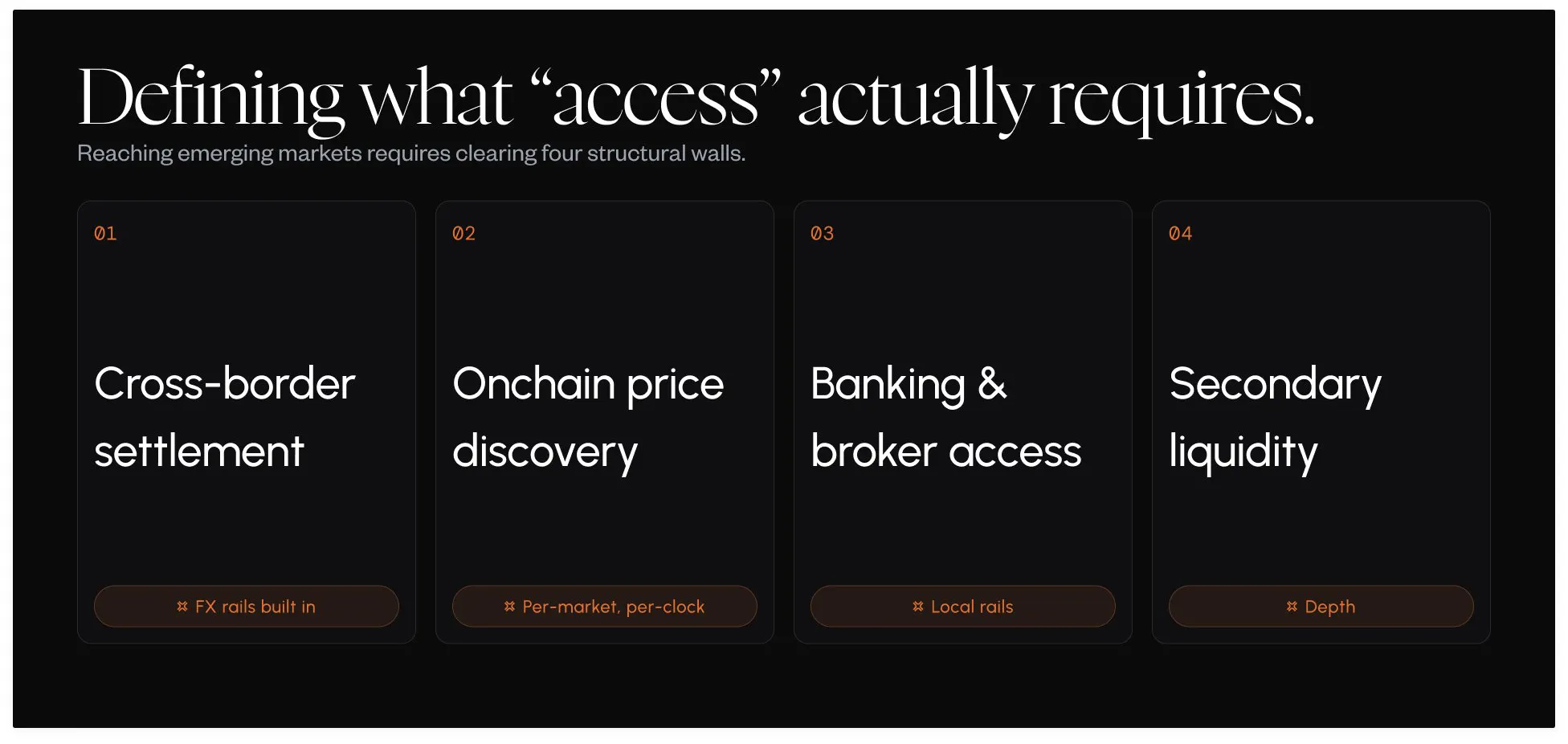
1. Cross-border access and settlement. The asset is priced in local currency, not dollars. Reaching it means wiring USD across borders, converting through FX, buying the asset, and settling, which takes days in each direction. And the local manager running these high-yielding funds serves domestic clients only. Access is constrained in both directions.
2. Onchain price discovery. EM assets do not run on one clock. Each market prices on its own regulator's cadence and calendar. A US-hours feed cannot reliably track them, leaving the asset without a dependable onchain reference to compose, lend, or settle against.
3. Banking and broker access. Most banks and brokers will not open accounts for crypto-linked entities, and the few that engage do so only on the strength of a relationship built over years. Without local banking and broker rails, there is no way to settle the cash leg or hold the underlying.
4. Secondary-market liquidity. Deep onchain liquidity exists for dollar-denominated assets. Almost none exists for Turkish lira, Brazilian real, or other EM-denominated instruments. The venues, market makers, and lending markets that would let global capital trade them have not yet been built.
The approach
Brix’s architecture starts from one premise: tokenization is not the product. Market structure is.
Wrapping a local instrument into an onchain token is the easiest layer to build and the least useful in isolation. What earns onchain capital’s attention is the surrounding system that lets the token compose, finance, settle, and price.
Brix focuses on four rails.
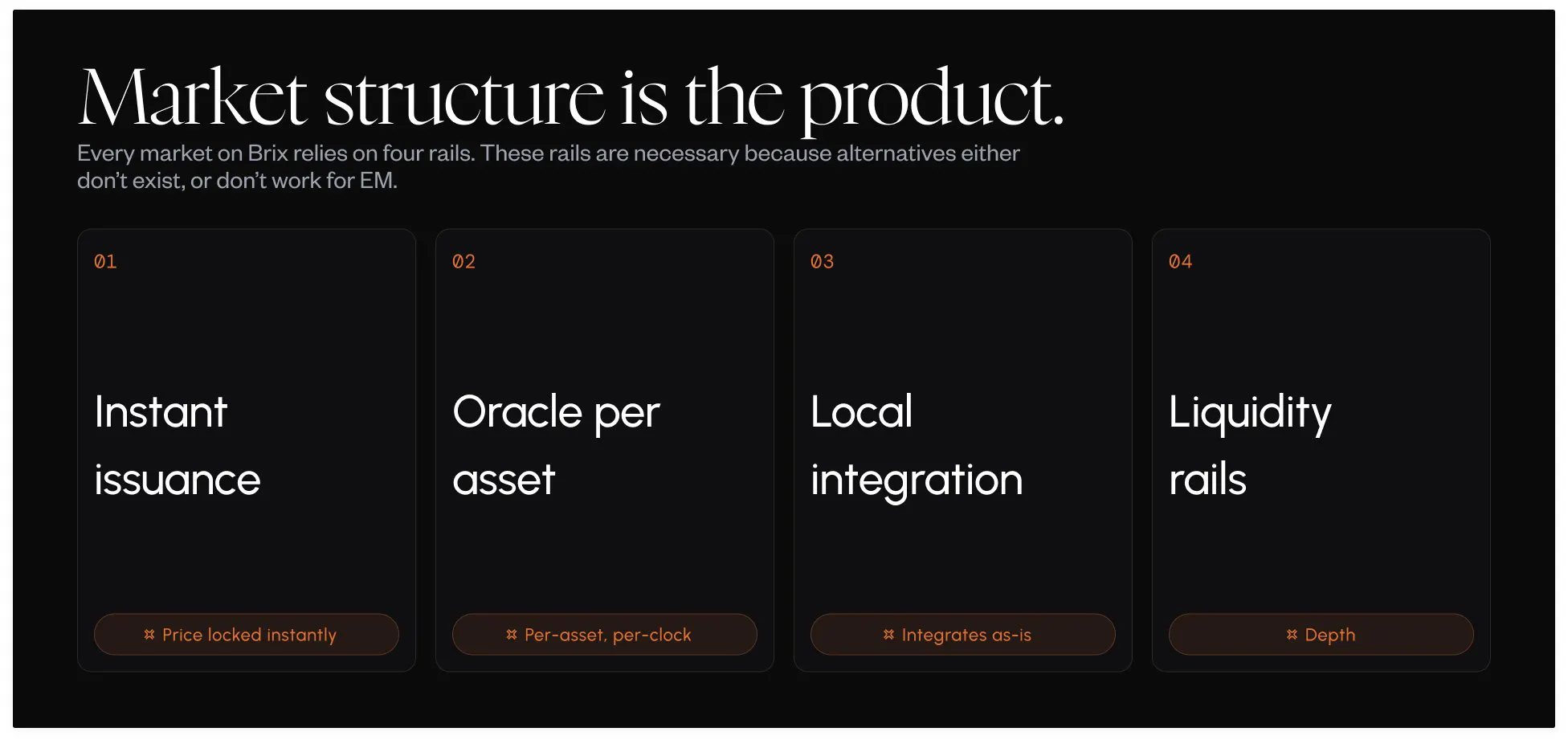
Rail 1: Instant USDC-to-asset issuance, FX and settlement absorbed.
The holder sends USDC and receives the tokenized asset. No wire. No FX desk. No settlement window.
Brix’s RFQ system pulls live quotes from multiple local conversion rails: OTC desks, exchanges, brokers, and aggregates them into a single primary-market price. The investor’s price is locked the moment the order is placed. The underlying conversion settles afterward through Brix’s broker and bank rails, even when local market hours have not yet opened.
Independent reserve verifiers continuously check those accounts. The backing of every token in circulation is provable in real time.
Rail 2: An oracle built for EM markets.
Emerging-market assets do not run on one clock. Turkish equities close on BIST time. Brazilian fund NAVs publish on CVM cadence. Indonesian markets observe holidays others ignore. A US-hours oracle cannot reliably price these assets.
Custom oracles per asset class are built in partnership with Redstone. Each instrument is anchored to the regulated source that already governs its underlying: fund NAVs, exchange close prints, or supervised dealer quotes, on the cadence required locally.
Between official reference points, the oracle moves deterministically along the asset’s known accrual or carry rule: MMFs accrue yield by the second; coupon bonds accrete cash flows. Each new official stamp resets the path. Risk teams can audit the oracle against the same source the regulator uses.
Rail 3: Local integration: legacy rails, no rebuild required.
Emerging-market institutions run on legacy rails. Brix integrates with that reality instead of asking local managers, custodians, or brokers to rebuild.
Brix handles cash-leg settlement through banks and brokers that already deal with the local institution, reconciles positions against the underlying records, verifies backing through independent third parties (fund administrators for funds, qualified custodians for securities, audit firms), and manages token flows via regulated digital-asset custodians.
Rail 4: Liquidity rails for EM-denominated assets DeFi has never natively priced.
Circle’s USDC, Aave, and others have built deep liquidity for dollar-denominated assets. Almost none exists for Turkish lira, Brazilian real, or other EM-denominated instruments. The venues, market makers, and lending markets do not yet exist.
Brix builds them.
Each asset is listed where capital trades: AMMs and orderbooks for secondary market liquidity, RFQ-based swaps and primary markets for institutional depth, and lending markets where it becomes productive collateral. Where organic depth is thin, Brix supplies baseline liquidity. Liquidations route through the same FX and settlement rails as issuance and redemption, giving risk teams a real unwind path to underwrite.
Together, these four rails make EM assets usable as DeFi-grade collateral: composable, tradable, hedgeable, and auditable. In doing so, they create the necessary market structure for adoption.
Each new strategy: yield vaults, lending markets, hedging instruments, etc, increases the value of the underlying for the next one.
What other approaches miss
Two adjacent approaches reach for the same demand and arrive somewhere different.
Synthetic exposure replicates EM currencies or yields without owning the underlying. Its price comes from futures rolls, basis assumptions, and position management — not the asset’s actual cash flows. DeFi protocols built on synthetics inherit that strategy risk: roll cost, basis sensitivity, and expiry risk.
That difference matters because institutional allocators, regulated funds, and treasuries cannot treat a futures basis trade as the underlying asset. Synthetic exposure caps the capital it can serve.
The underlying does not.
Credit-first platforms originate loans themselves, becoming credit funds in markets where local banks already own the relationships, legal frameworks, and recovery infrastructure. When underwriting fails, the damage spreads to the platform, its LPs, and trust in the category.
The model also limits scale to what the platform can underwrite. Money markets, equities, and bonds sit entirely outside that reach.
One stack, many jurisdictions
Brix’s tech stack is built to deploy across jurisdictions with different regulatory postures. That choice makes the platform expandable across emerging markets, not trapped in one.
Where local tokenization is permitted, Brix integrates directly with banks, asset managers, and brokerages that issue the tokenized asset on Brix rails inside their jurisdiction. Where it is not, Brix uses its global issuance structure with a local partner holding the regulated underlying.
The result is one stack, two deployment modes. Institutions keep their operating model. Regulators see a structure that fits their existing framework. Brix adapts to the market.
That is what makes it expandable.
Operating across emerging markets creates risks a US-only tokenization model does not face. Brix handles them in the architecture, not as exceptions.
Risk management
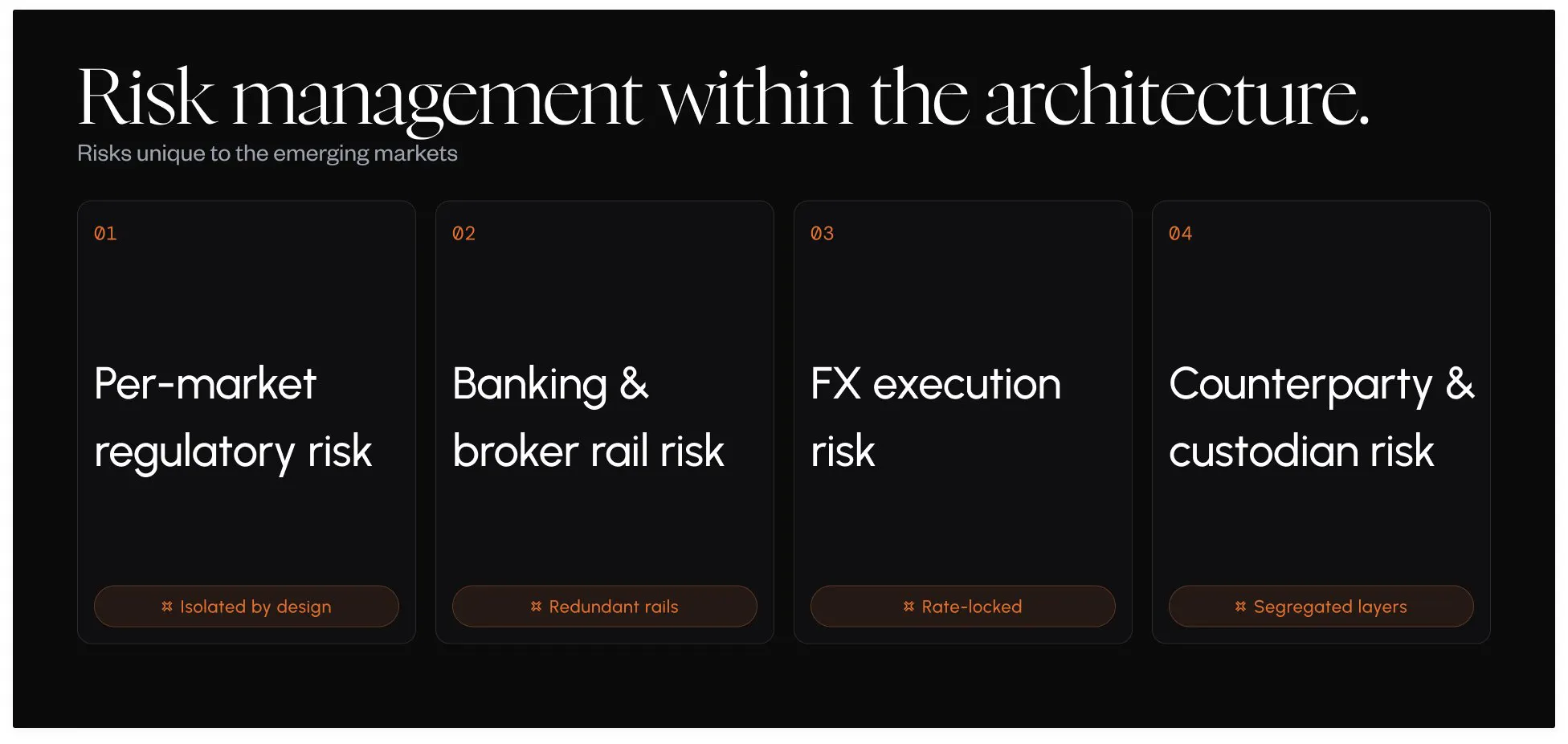
Per-market regulatory risk. Each market has its own securities and digital-asset framework, and rules shift on local timelines. Brix isolates each jurisdiction. A reversal in one market does not affect the others. Each new regulatory posture becomes a deployment parameter, not a rebuild.
Banking and broker rail risk. Local accounts are the hardest dependency to secure and the easiest to lose. Brix runs each market through multiple bank, broker, or asset-manager relationships from launch, with fallback execution channels in place. No single relationship can halt operations. These relationships compound across markets and cannot be bought overnight.
FX execution risk. Mints clear continuously. Redemptions are batched against locked rates. Off-market redemption fees protect against stale price extraction.
Counterparty and custodian risk. Brix does not custody, audit, or compliance-screen its own assets. Tokens sit with digital-asset custodians. Compliance is handled by licensed providers. Reserves are verified by independent third parties. No single layer is both operator and auditor.
Bringing emerging markets onchain
Brix is built to bring emerging-market finance onchain.
The first market — the Turkish lira — is now live. The second will be announced soon. Each deployment will speed up future markets. The vision? Funds, equities, bonds, currencies, and commodities from emerging markets have a compliant path to global capital, which in turn doesn’t require local banking, brokerage, or a presence to access these assets.
The question is not whether emerging markets come onchain. The question is which platform is already there when the macro shifts.
In emerging markets, tokenization is not the product. Market structure is. We're building Brix to be that market structure for the world.
TRADE THE MACRO
Article by @degentellect with editorial input from @alpergintr @0xismailemin, @abigailcarlson_, @turgutalpgunal, @0xNuggan