TL;DR
From June 2023 to today, 100 TRY parked at the CBRT's compounded overnight reference rate has turned into ~356 TRY. That’s about 1.79× your money in USD terms, through a 75% inflation peak and multiple geopolitical shocks.
This isn’t a market anomaly waiting to be arbitraged. It's a textbook risk premium, and the governing bodies that pay it out are structurally reinforcing the premium, not eroding it.
wiTRY is the yield-bearing wrapper of iTRY, our 1:1 TRY-pegged stablecoin. It's the first onchain primitive that gives global allocators clean, composable exposure to the long leg of this trade.
I - Why the lira carry has worked
Turkey is the modal high-yielder in the post-2023 EM cross-section, and the realized numbers are the cleanest evidence the carry premium is alive.
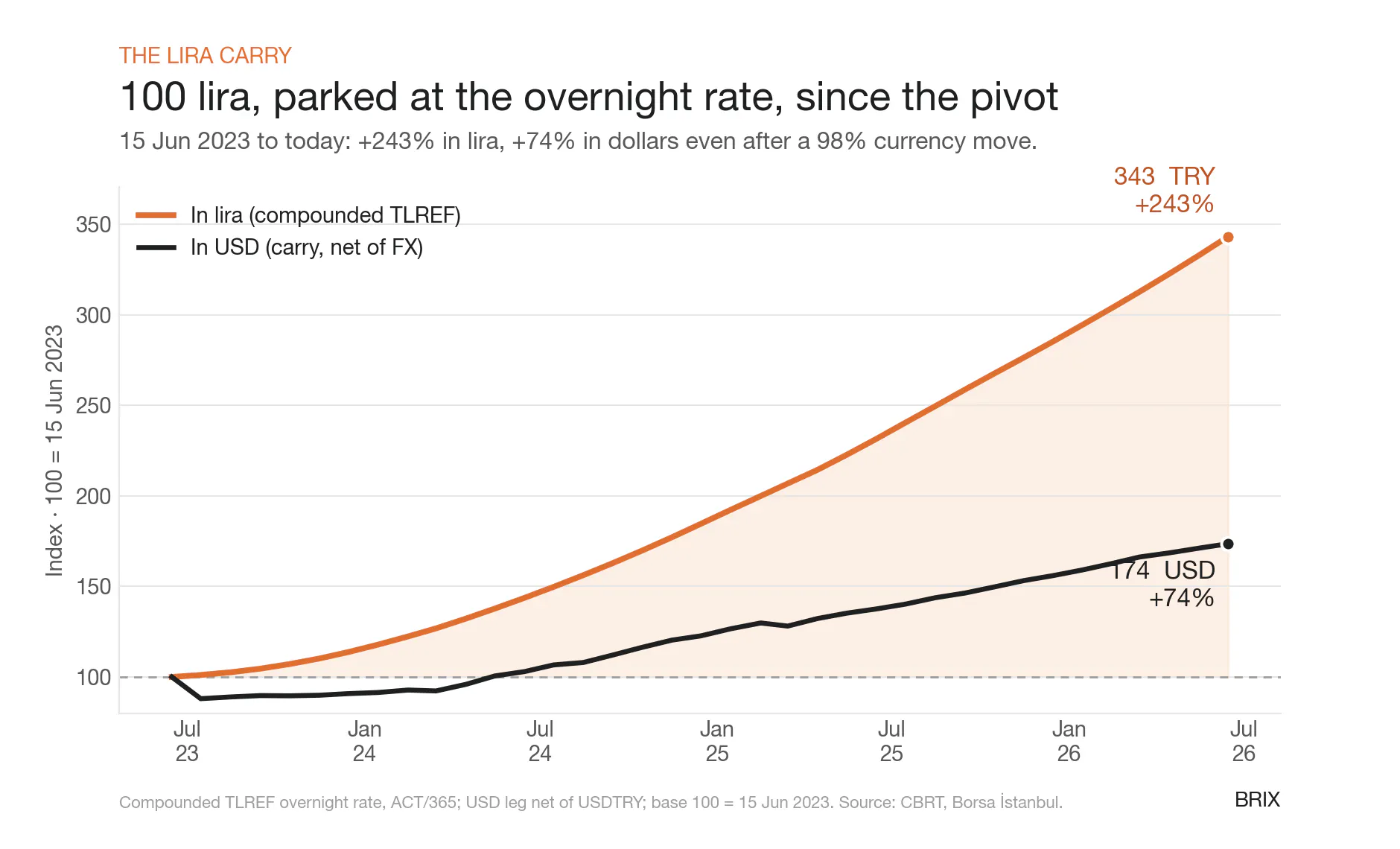
This index shows 100 TRY at compounded TLREF starting June 15, 2023, after the switch to more orthodox macroeconomic policies. By June 2026 that position is worth ~356 TRY, about 1.79× in USD at spot. That's +79% in USD over three years, roughly 21% a year, all through one of the most geopolitically volatile windows in recent EM memory.
Three things had to be true for this to happen.
(a) The reaction function changed. The CBRT after mid-2023 explicitly targets a positive ex-ante real policy rate. They hiked, held restrictive, and didn't blink when some camps demanded cuts. The conditional distribution of TRY returns has structurally shifted. This is not a marginal tweak.
(b) The KKM put got unwound. KKM, the FX-protected deposit scheme, was a state-written put on TRY, a contingent FX liability on the central bank's balance sheet. Its systematic wind-down through 2024–2025 removed left-tail mass from the lira distribution by killing the conversion incentive at stress points. It's the single biggest improvement in TRY's risk profile in a decade.
(c) Foreign holders came back. Non-resident holdings of TRY government bonds and equities went from sub-1% of float in early 2023 to a peak of ~10% of the government-bond stock in early 2025, settling around ~7.5% since. That widened the forward and cross-currency basis markets and narrowed the on-/off-shore wedge enough to express the trade at size.
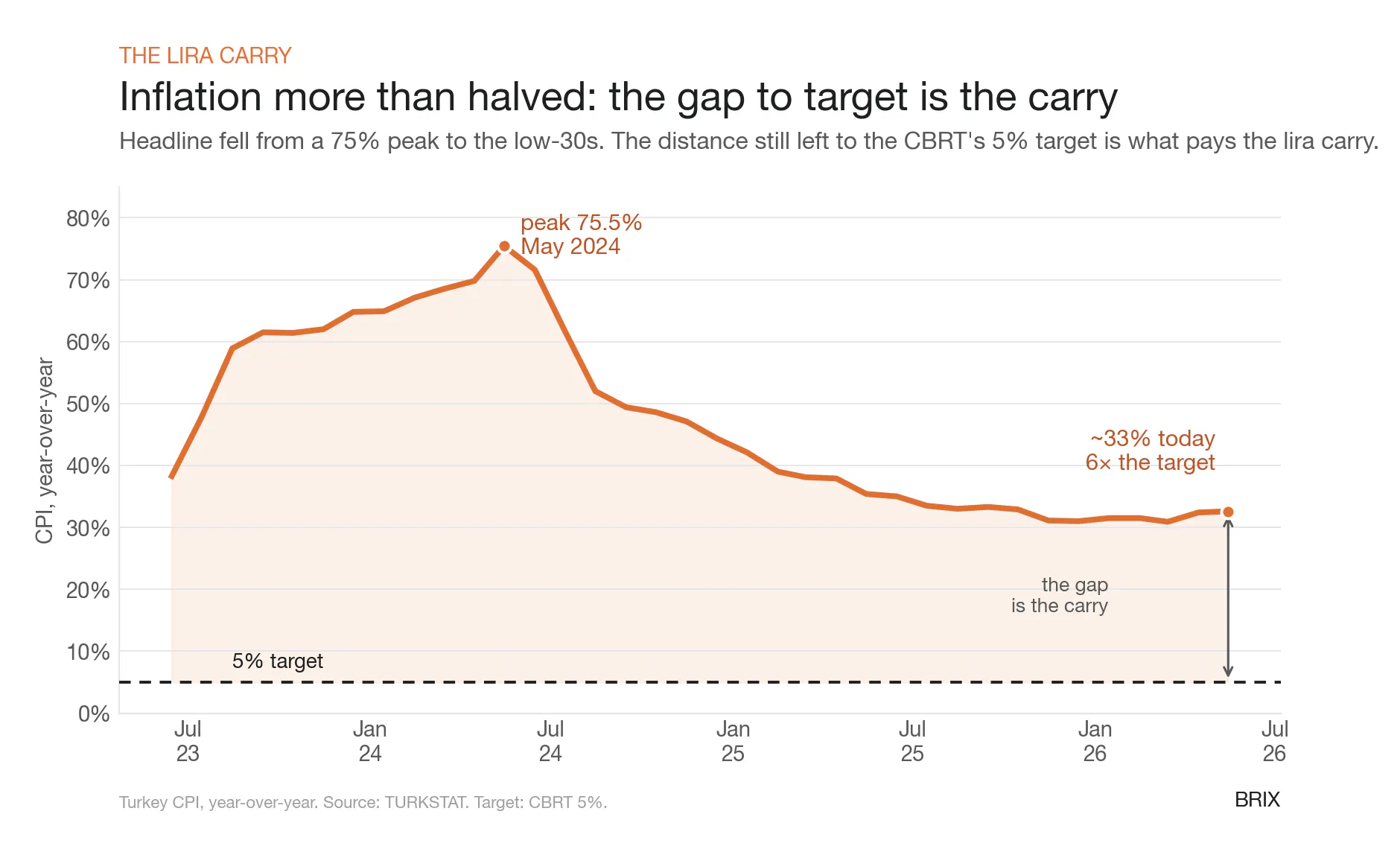
CPI peaked at 75.5% in May 2024, eight months after the pivot, as the previous regime's pass-through washed through. From there it more than halved: 44% by end-2024, ~31% by end-2025, and through 2026 it has held in the low-30s, with a Middle-East energy shock keeping the headline near 32.6% by May 2026. The CBRT has matched that with discipline, holding the policy rate at 37% rather than chasing premature cuts. Disinflation here is real but deliberately gradual, and that is the point: the gap between TRY rates and the 5% target is exactly what pays the carry. As long as inflation runs in the 30s and a credible central bank holds rates restrictive to bring it down, the differential stays wide, and the carry stays wide with it.
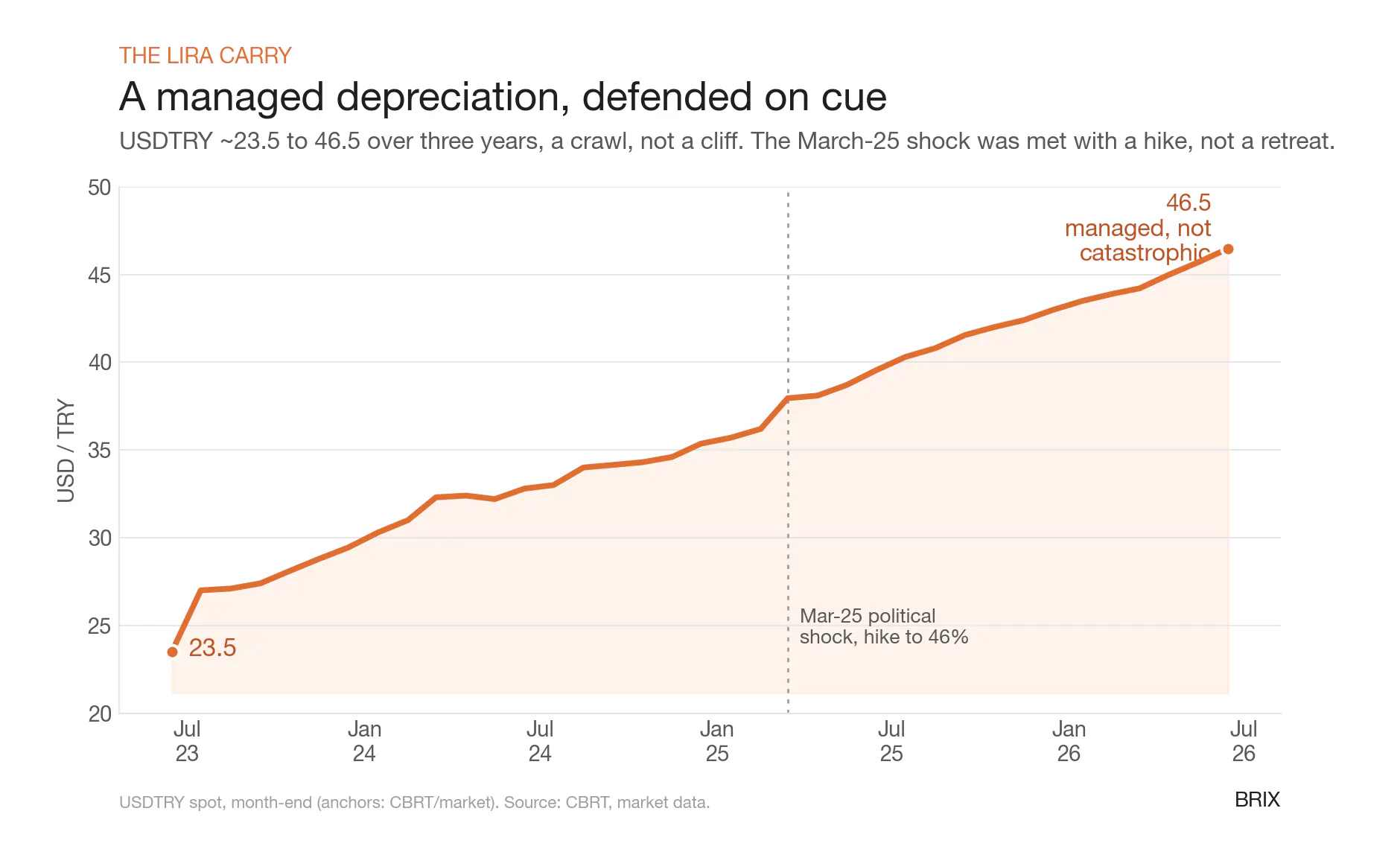
USDTRY spot went from ~23.5 to ~46.7, a ~99% rise in the pair, the lira shedding roughly half its dollar value, over three years. That sounds bad until you realize the compounded rate differential earned ~245% in TRY over the same window. The depreciation was managed, not catastrophic. Even the March 2025 political shock, the loudest left-tail event of the cycle, produced a temporary spike that the CBRT met with a hike to 46% (the overnight corridor topping ~49%). The CBRT did exactly what the theory says a credible central bank should do.
II - Why it keeps working
The forward case rests on four pillars that reinforce each other, not independent mechanics.
(i) The yield gap exists because of the disinflation policy, not despite it. The CBRT has committed to keeping real rates positive. And not only that, but "real" is measured against what people expect inflation to be, and expectations are still running above the official forecast path. So the nominal rate has to stay very high. The carry isn't a free parameter; it's a state variable that has to stay large until expectations re-anchor.
(ii) Inflation falls slowly, which is actually good for the trade. Service prices, wage indexation, and imported-goods pass-through are sticky. They don't reset overnight, and 2026's grind through the low-30s proves it. Realistic paths put headline inflation in the high teens by end-2027. Slower disinflation means the high-rate regime, and therefore the carry, persists longer. The carry shrinks gradually, it doesn’t vanish from one day to the next.
(iii) The government wants people holding lira. "Lirafication" is explicit policy: rebuilding a domestic savings and lending system denominated in TRY rather than in dollars. This creates a persistent structural buyer for high-yield lira instruments. wiTRY is on the right side of that policy gradient, not against it.
(iv) The central bank will defend the currency before a crisis, not after. The CBRT has repeatedly shown a proactive approach, including pausing its cutting cycle on the energy shocks caused by the Iran-Israel war or the local political events of March 2025, rather than easing through it. The reaction function is no longer itself a source of TRY left-tail risk. This inverts the historical pricing of TRY crash insurance, and compresses the embedded risk premium allocators have traditionally demanded.
The Central Bank’s credibility (iv) is gradually re-anchoring expectations, which drives the carry (i), to support the disinflation process that is measured in years and not months (ii), and supplies the domestic demand that keeps the whole transition orderly (iii).
III - wiTRY as the DeFi-native vehicle
Traditional access to the lira carry requires onshore deposit accounts, an NDF book with a prime counterparty, or a cross-currency swap line: instruments gated by jurisdiction, KYC, ISDA papering, and minimum ticket sizes that exclude most allocators. wiTRY collapses all of that to a single composable asset:
- Settlement finality. No correspondent-banking layer, no FX-window queue, no convertibility lag.
- Transparent reserves. iTRY's backing is attestable onchain in a way no onshore deposit can match.
For a quantitative allocator, wiTRY is a clean carry leg with daily-marked NAV, deterministic yield accrual, and a transparent collateral chain back to the underlying lira reserve. There is no equivalent in TradFi.
IV - Bottom line
The Turkish lira carry trade isn't an inefficiency waiting to be arbitraged. It's a priced risk premium, sustained by structural CPI persistence, a credibly orthodox central bank, and a balance sheet that's been materially de-risked through the KKM unwind. The literature explains why carry premia exist. Turkey's regime change addresses precisely the dimensions of that risk that historically dominated TRY's left tail.
wiTRY is the onchain expression of this premium. So long as the CBRT continues to compensate lira holders for bearing inflation and convertibility risk, and the structural case for this is firmer in 2026 than at any point in the prior decade, wiTRY accrues that compensation onchain.